
Repealing the Estate tax, a big deal or just more noise?

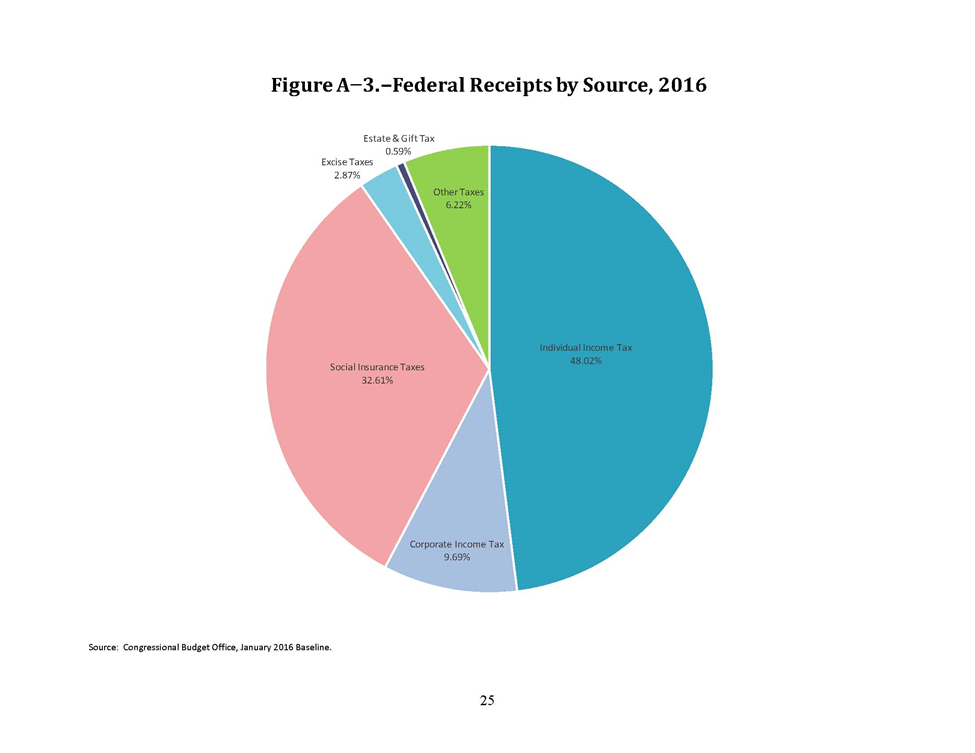
As previously discussed (here), the Joint Committee on Taxation (JCT) has conducted a study of the source of tax revenues for 2016.  As detailed in the JCT study, the Estate and Gift Tax revenues are expected to be 0.59% of the total tax revenue.  See Figure A-3, pg. 25 of the JCT report, as follows:
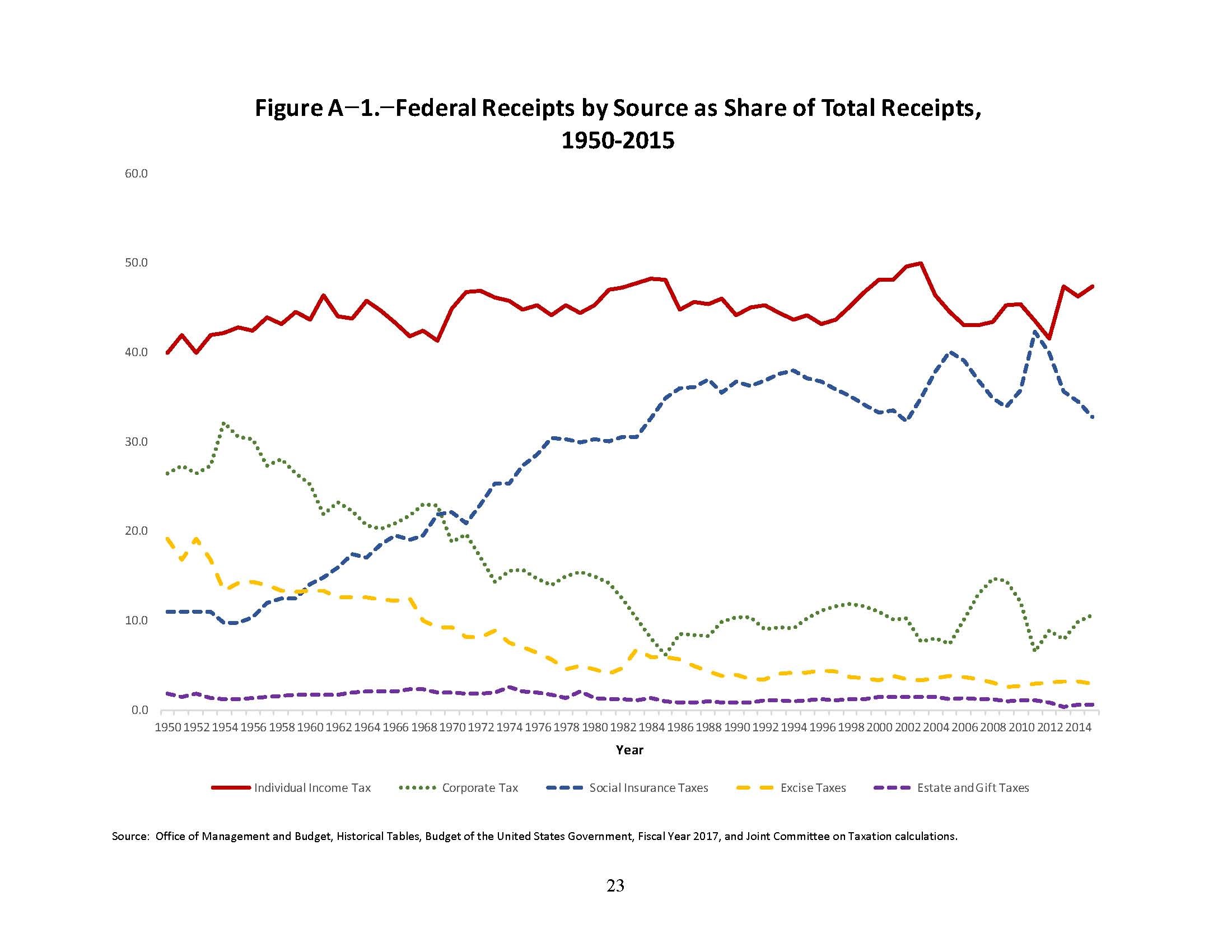
Furthermore, Figure A-1, pg. 23 of the JCT report reflects that since 1950, the revenues from the Estate Tax has generally declined.  See Chart below:

What is interesting about these charts (A-1 and A-3, above) is that despite the hullabaloo about repealing the estate tax, see this Washington Post article about the most recent attempts by Republicans in the House voting to repeal the estate tax, the estate tax barely makes a blip in total income received by the IRS and since 1950.

Why does the estate tax represent such a small portion of tax revenue?  The simple answer is that the majority of people are exempt from paying estate and gift taxes.  Most people are exempt from estate and gift taxes because the law allows most people to five away either: 1) during their life up to $1,000,000 or 2) at death (as of 2016) is $5,400,000.  Also, annual gifts do not impact the lifetime gift exemption or at death exemption.  The annual gift exemption (as of 2016) is $14,000.  Also if you are married, (with tax planning) you can double the amount of gifts that are exempt from the gift and estate taxes.  Additionally, if you are married, you can transfer your wealth to your spouse (with tax planning) tax free at your death.

So then why is repealing the estate and gift tax so important to Congress?  Simply put, it is an election year and the Congress men and women need their wealthy donors to know that they are watching out for them.  That's the argument of the Washington Post article.  See also the Tax Policy Center's estimate that only about 2 out of 1000 people who die are affected by the estate tax.

See Forbes for arguments in favor and against the estate tax and/or its repeal.  See also USA Today arguing that the claims for harming small business and forcing the rich to sell assets are unfounded, or this USA Today article claiming that the estate and gift tax "punishes success".

If you know an individual who is liable for estate and gift taxes and have specific and credible evidence of their estate tax or gift tax liabilities, contact our office to help you evaluate your information and whether you can claim a tax award from the IRS.  The IRS pays between 15-30% of taxes, penalties and interest collected for unpaid estate tax liabilities.
Taxing the Individual vs. Taxing Corporations: History shows the burden is on Individuals and not Corporations

As discussed in the TaxProfBlog the Joint Committee on Taxation has released its overview of the federal tax system.  Noteworthy in the JCT’s finding is in table A-1 on pg. 23, the corporate income tax revenues received by the IRS has steadily declined since 1950, while individual income taxes and social security taxes continue to rise.  See the chart below:

One possible explanation for the decline in the corporate tax receipts may be the erosion of the corporate tax base by U.S. multinational corporations (“USMNCs”) and their profits shifting from the United States.  See TaxProfBlog and Kimberly A. Clausing (Reed College), Profit Shifting and U.S. Corporate Tax Policy Reform.

Clausing argues that the U.S. is losing over $100 billion dollars a year due to profit shifting efforts of USMNCs.  See Chart below.

Ms. Clausing states that 98% of the profit shifting occurs by USMNCs to jurisdictions that taxes the USMNCs at less than 15%.  Finally, she states that the revenue decrease has grown 5 times over the past decade due to increase profit shifting by USMNCs. 

To combat the erosion of profits to offshore jurisdictions, Ms. Clausing proposes the following small changes to the current taxing regime:

  1. Repeal the check the box regulations that facilitates income shifting [for more information on check the box regulations and use in international tax planning, see this Wikipedia article];
  2. Tougher earnings stripping laws [Treasury has already instituted additional regulations to curb earnings stripping, see my blog]; and
  3. Anti-inversions rules such as an exit tax [See my earlier blog about imposing an exit tax to dissuade corporate inversions]. 

Ms. Clausing also advocates for the following fundamental changes to the existing taxing regime:

  1. Worldwide consolidation of corporate returns for tax purposes
  2. Formulary apportionment of international corporate income, using a method similar to that used by U.S. states in taxing national income.

Ms. Clausing’s proposal suggests that the U.S. should move to a territorial tax system.  While some have advocated the territorial tax systems would create jobs and raise wages for U.S. workers, see this article by Curtis S. Dubay and the Heritage Foundation, others (Center on Budget and Policy Priorities) have advocated that such a transition would: 1) create greater incentives for USMNCs to invest and book profits offshore, 2) reduce wages in the U.S., 3) would cause larger budget deficits by draining corporate tax revenues, and 4) would shift the tax burden to domestic businesses and small businesses.

Regardless of the solution proposed by either side, the simple fact still remains that individuals in the U.S. continue to bear the brunt of the tax burden, while corporations continue to avoid paying taxes.

If you have specific/credible information about corporations avoiding the payment of tax through transfer pricing, inversions and earnings stripping, you can get involved in preventing/limiting the tax avoidance by filing an IRS tax whistleblower claim.  The IRS pays an award between 15% to 30% of the tax collected to a whistleblower with specific and credible information about a corporate taxpayer’s avoidance of tax (through transfer pricing, inversions and earnings stripping).   Contact us if you want to file a tax whistleblower claim.

Lee Martin, Director IRS Whistleblower Office: Guest Speaker at TWLF's Attorneys Conference Call

On May 11, 2016, the Tax Whistleblower Law Firm held its bi-monthly conference call between tax whistleblower attorneys.  During this conference call, Lee Martin, the Director of the IRS Whistleblower Office, along with his representative from the IRS Chief Counsel, were in attendance and answered questions from the tax whistleblower attorneys as presented by Tom Pliske.

Some highlights of Director Martin’s responses are as follows:

  • Director Martin views his role is to pay awards and make the whistleblower program successful.
  • Director Martin stated that he was available to review a whistleblower case if a whistleblower or attorney was not satisfied with the outcome of the IRS’ determination. In fact, he encouraged whistleblowers and their representatives to contact him to review their case if there is a disagreement between the whistleblower and their representative and the IRS determination.
  • Director Martin anticipated paying more awards in fiscal year 2016.
  • Director Martin mentioned that his office is working with the IRS Congressional liaison to prepare legislation that would: a) create legal protections for whistleblowers and b) would increase protections for taxpayers against whistleblowers using the taxpayers’ information against them.
  • Director Martin also stated that while a point system for differentiating whistleblower cases that are vetted by attorneys may sound like a good idea, pragmatically speaking he does not see that it is currently a possibility.  He stated that even though cases are vetted by attorneys, the cases still end up with the Whistleblower Office; and his job is to process all cases regardless if the claims have been vetted by an attorney.
  • Director Martin stated that the de-briefing timelines and determination letter processing timelines in former Deputy Commissioner Miller’s and Deputy Commissioner Dalrymple’s guidelines are targets but are not set in stone.
  • Director Martin commented that he and the IRS whistleblower program have the full support of Commissioner Koskinen.  He also stated that there were no advantages to having the IRS whistleblower program as an independent from IRS.  Director Martin also clarified that he maintains independent autonomy over whistleblower office and does not report to a board within the IRS to make decisions or to conduct and administrative appeal.
  • Director Martin stated that the Informant Claims Examination (“ICE”) unit is moving back to SBSE to be more transparent.  He also stated that the rationale for the movement was it allowed the IRS to have the ability to better utilize analysts.  He then stated that this would apply to all whistleblower cases (7623(a) and 7623(b)).
  • With respect to cases that have been open for 10+ years, Director Martin stated that there may be a valid reason why the cases remained open.  He reiterated that it does not hurt the process for whistleblowers and/or their counsel to inquire with the assigned analyst.  He further stated that the IRS whistleblower office is working on getting through every case, and to pay more awards.  He then stated that because he is trying to get more awards paid, the numbers of cases and awards paid are increasing.
  • Finally, with respect to Title 18 and Title 31 penalties and whether they are collected proceeds, Director Martin stated that these penalties are not subject to an award.  He stated that the IRS whistleblower office has no policy as to these penalties, and that he would defer to Congress to determine if they should be included in the term "collected proceeds".

If you are a tax whistleblower attorney and are interested in participating in the conference calls, contact our firm to have us inform you of the next call and how to participate. 

Alternatively, if you have specific and credible information (including documents) of a taxpayer’s tax violations/liabilities, contact us to have us review your claim for an award from the IRS.  As a reminder, the IRS pays 15-30% of the tax, penalties, interest and other amounts collected from non-conforming taxpayers to whistleblowers that provide specific and credible information to the IRS.